

Safety Scenario - Safe University
Quietly Protect Yourself from Bullying and Harassment¹


Even without bruises or scars, bullying can hurt you — and you deserve support³
Discrete SOS
Your Exit Plan
Trusted Contacts
Safety Journal

Have you ever felt something like this?
Sometimes you wonder: ‘Is it really bullying or am I overreacting?’
You feel alone – ashamed to talk about it to anyone.
You constantly watch what you say or do, afraid of giving them more reasons to target you.
It’s not your fault — and many others have been through the same. You’re not alone¹¹
Nearly 2 in 3
Almost 62% of students and staff in European universities have experienced at least one form of gender-based violence since starting their studies or work. This alarming figure includes psychological, physical, and sexual violence, as well as online harassment.
Source: UniSAFE Final Report (2022)
1 in 3
One in three students (31%) has been subjected to sexual harassment within the university environment. In many cases, the perpetrators are not strangers but peers or academic staff, which creates a hostile and unsafe space for learning.
Source: UniSAFE
Only 1 in 8
Only 13% of survivors report the incident to university authorities or the police. This extremely low reporting rate highlights a critical gap: most victims remain silent due to fear of negative consequences for their academic career or a lack of trust in the system.
Source: UniSAFE
Most students (87%) who experience harassment never report it, often waiting too long or believing the incident wasn’t "serious enough" to count as violence. Don’t be one of them.


Indicators That It's Time to Act⁵
-
Someone regularly insults, humiliates, or mocks you – even if they call it a joke.
-
You avoid certain halls, classes, or chats because you’re afraid of running into them.
-
They try to isolate you or control who you hang out with.
-
You feel trapped, ashamed, or like you might somehow be at fault.
-
You’ve thought, ‘If I speak up or report this, they or he will only make my life worse.’
What is Safe University Safety Scenario?
Discrete SOS Mode²
A discreet emergency mode that looks like a regular puzzle game. No one will suspect, even if your partner checks your phone.
Trusted Contacts
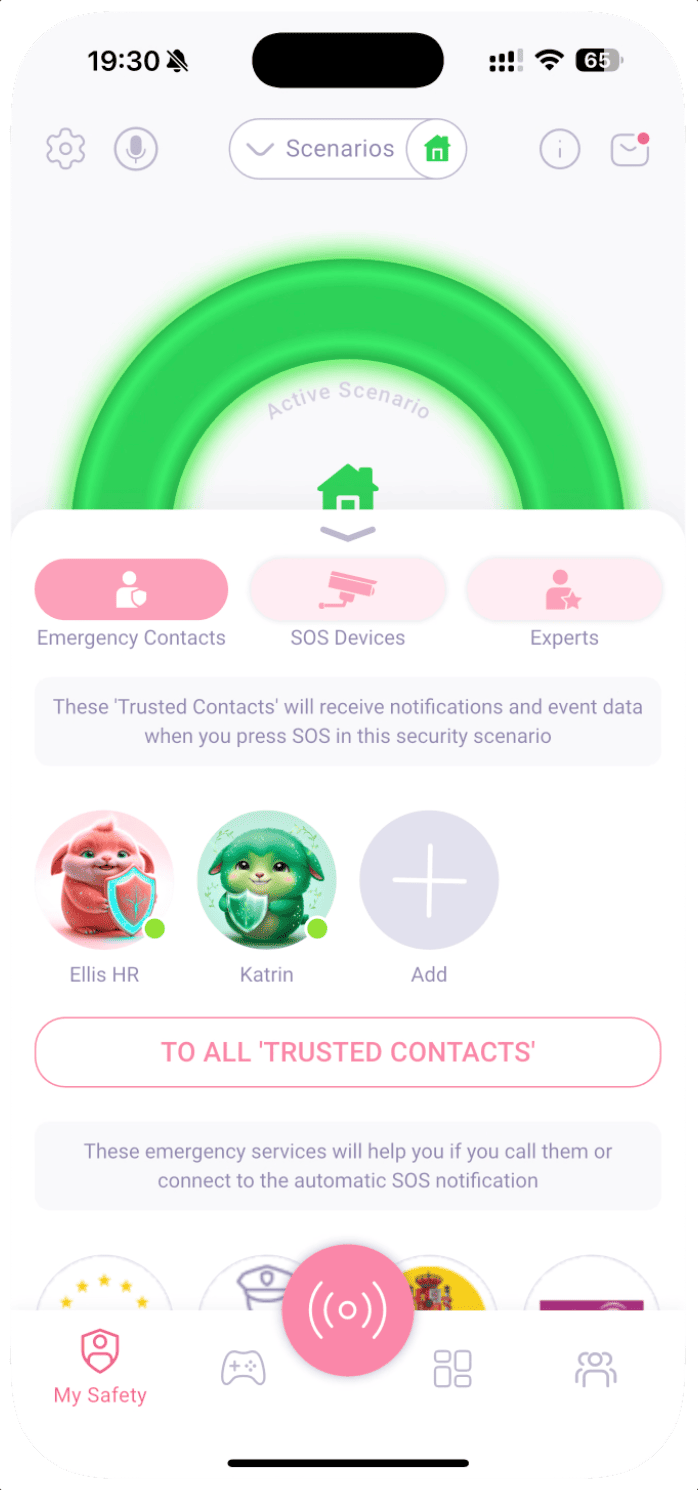
You decide who gets alerted — a friend, family member, or campus security. Customize each 'Trusted Contact' — share only the information you’re comfortable with to support your safety on campus.
Experts
Here you’ll find real, confidential support from verified experts and trusted organizations who understand what ‘Safe University’ truly means — whether you need psychological support, guidance on dealing with the university administration, or just someone who listens without judgment.
Safety Centre
In the Safety Centre, you’ll find a step-by-step plan to help you feel more confident at university. Take a quick test to see where you might need clarity, get expert advice, and keep a private Safety Journal — just for you, protected by a passcode. It’s your space for reflection, decisions, and support.
Advanced Privacy Protection
Your data and evidence are always secure. Extra passcode, hidden icon, and all your information stays private — only you control it.

“At first, I was skeptical” I didn’t think I’d ever need it. But I quietly kept a log of the insults — using the hidden “game mode” in the Safe University scenario. When it escalated — when they cornered me after class — I pressed and held my screen. It looked like a normal app, but it was actually the SOS in disguise.
My roommate and my older sister — both set as Trusted Contacts — got the alert. While my sister phoned the school counselor, my roommate arrived within minutes with another friend. They interrupted the confrontation and helped me get out safely. That quick intervention might have saved me from something much worse.
How to start?
The first and most important thing is to keep your use of the app discreet — that’s where you should start. Everything you do in the app can remain hidden from anyone targeting you. WomanAid is designed with care for those living under fear, intimidation, or social pressure.
Step 1. Download the app safely
Install WomanAid in a private, secure place. After installation, follow the setup tips to enable the Interactive Mode with a neutral interface⁷, and configure your Safety Scenario: Safe University.

Step 2. Set up the “Safe University” scenario
Make sure to select the option “Make Interactive Mode the main screen” to make the app interface look neutral. To exit the neutral screen, press and hold the bottom buttons for 3 seconds. To send a quiet SOS alert⁸, press and hold the center button at the bottom of the screen.

Step 3. Add your Trusted Contacts
Choose 1 to 5 Trusted Contacts — people you truly trust. WomanAid notifies them only when you activate the SOS alert. You control what each contact receives⁹ — your location, a short ambient-sound clip¹⁹ (where allowed by law and with consent), a message, or all of these.

Step 4. Follow your personalized action plan
Track your progress through the Safety Centre – Safe University section. It’s your private guide through every stage — with a step-by-step action plan and expert support just when you need it most¹⁰.


Imagine 3 Months From Now…
You walk onto campus without fear. You check your phone – no cruel messages waiting. You meet your friends with a smile instead of anxiety. You feel free, strong, and proud that you took action. This future can start today – one small step can change your life.¹⁵
Ready to Take Back Control?¹⁶
Install WomanAid and activate your free Safe University plan today.
Get step-by-step guidance and the confidence to take positive steps — starting now..
No credit card, no commitment – just help.
App icon is discreet. You can delete it anytime¹⁷.
The WomanAid app includes an optional Interactive Mode with a neutral interface for delicate situations. It uses simple visuals that look calm and familiar, without ads or distracting content. To return to the regular view, simply long-press the bottom buttons for a few seconds.
No. WomanAid is fully GDPR-compliant. All your data is encrypted and stored only on secure servers. In the Safe Relationship scenario, even your avatar is hidden. No ads. No tracking. Your safety comes first.
The core Safety Scenario — Safe University — is free to use. Essential functions such as the quiet SOS alert, Trusted Contact notifications, and in-app audio recording within the Interactive Mode are available at no cost. Some extended features — like secure cloud storage of recordings or audio sharing with Trusted Contacts — require additional resources and may be offered via a paid subscription or supported by local NGOs, depending on your country. Even on the free plan, WomanAid helps you stay protected: your SOS alert is sent quietly to your Trusted Contacts along with step-by-step guidance on how they can support you.
You’re safe — a visible countdown and a 15-second cancellation window let you stop an accidental SOS. Hold the top-right envelope icon for 3 seconds and press “Stop SOS” to cancel.
Absolutely. WomanAid isn’t about forcing you to confront anyone — it’s about keeping you safer, one step at a time. The Safe University scenario helps you prepare quietly, with no pressure.
That’s why you choose your own Trusted Contacts. People who actually care. When you activate Safe University, they’ll receive your location and a clear action plan — instantly and silently.
Many students postpone taking action, hoping things will get better. The Safe University plan helps you notice early warning signs, safely document what’s happening, and set healthy personal boundaries — before things escalate. It’s not about panic — it’s about awareness, support, and preparation.





What if you could set real goals for your life at university and finally reach them?²²
01
Campus Safety Goals
I want to feel safe walking across campus, even in the evening.
02
Campus Safety Goals
I want to stop laughing off hurtful “jokes” and start standing up for myself safely.
03
Campus Safety Goals
I want to have at least one trusted person at university I can talk to honestly about what’s happening.
04
Campus Safety Goals
I want to heal after harassment or bullying and slowly learn to trust people again.
05
Campus Safety Goals
I want our group to handle conflicts with respect — without gossip, humiliation, or pressure.
With Mental Flow in WomanAid, you can choose what matters most: feeling safe on campus, building supportive friendships, reducing anxiety, rebuilding confidence after bullying or harassment, or learning to set healthy boundaries.
Set your goal — and get micro-plans and daily practices that help you move forward, step by step.
This is a Premium feature available with a subscription.
We didn’t call it bullying. But the constant jokes, the whispers, and the way people went quiet when I walked into the room were louder than any insult.
I felt like I was disappearing in my own university.
I chose the ‘Rebuild Confidence After Bullying’ goal in Mental Flow — and it helped me take the first small step. Now I give myself one hour a week just for me: no pressure, no pretending, just space to breathe and feel grounded again.
Slowly, I’m finding my way back to myself — and to people who treat me with respect.
Clàudia, 37
WomanAid is not only about crisis — it’s about growth and confidence, every day.

But I don’t have big problems at university — why use WomanAid?²⁴
-
Maybe you sometimes feel isolated or alone, even if no one is openly hurting you.
-
Maybe you want to break the habit of suffering in silence — to stop hiding and feeling invisible.
-
Maybe you want your campus life to be not just safe, but positive and empowering.
Isn’t it too much to use an app for bullying at university?
Not at all. We check the weather, plan our day, and count steps — why not support your peace of mind on campus too? WomanAid is private, easy, and flexible. You only use the tools that work for you.

You may not need it.
But she might²⁴
Not every young woman dares to ask for help. But that doesn’t mean she doesn’t need it.
Maybe she hides her pain behind a smile.
Maybe she makes excuses for those who hurt her.
Maybe she keeps her phone on silent and avoids looking at messages.
Maybe she insists “I’m fine” even when you can tell she’s not.


Don’t wait until she says “I need help.” She may never say it²⁶.
Hidden signs that someone may be facing bullying or harassment.
Here’s what you may notice:
-
She finds excuses to skip classes or campus activities.
-
She laughs off mean comments as “just a joke.”
-
She has become unusually quiet and withdrawn.
-
She actively avoids certain people or places at university.
-
Her grades or mood have suddenly gotten worse for no obvious reason.
-
She looks anxious or fearful whenever a certain person’s name comes up.
👉 If even one of these feels familiar…
Don’t hesitate. Just share WomanAid. The Safe University scenario will guide her — privately, step by step.

“They’re just joking…”
...and other lies we tell ourselves.
Denial is the most dangerous comfort zone.

What if she’s waiting for someone — just one person — to quietly tell her: You don’t have to live like this
🫂 Be that person²⁷.
WomanAid won’t ask her questions. It will just be there. Silently, safely, when she’s ready.
One small act = one possible life saved²⁸
Most women never report. Most suffer silently. You can break that pattern. Statistics don’t lie:
Campuses are not safe havens.
Universities are often viewed as "intellectual sanctuaries," but the reality for many female students is starkly different. The UniSAFE project, the largest European study on the topic, revealed that nearly two-thirds (62%) of respondents have experienced some form of gender-based violence in an academic setting. This ranges from psychological abuse and online harassment to physical violence and sexual misconduct. For thousands of women, the university experience is not defined by learning, but by navigating a hostile environment. Source: UniSAFE Project, "Gender-based violence in research organisations and universities in Europe," 2022.
Silence is the norm, not the exception.
Official university records rarely reflect the true extent of the crisis because the vast majority of victims never file a complaint. Data indicates that only about 13% of students who experience gender-based violence report it to university staff or the police. The hierarchical nature of academia creates a unique barrier: female students often fear retaliation regarding their grades, loss of supervision, or damage to their future careers if they accuse a professor or a peer. Consequently, abusers often remain in positions of power, unchecked. Source: European Institute for Gender Equality (EIGE), "Gender-based violence in academia," 2023.
Violence sabotages academic futures.
The impact of gender-based violence extends far beyond immediate emotional trauma—it actively dismantles women’s education. Victims frequently report skipping lectures to avoid their abusers, dropping specific courses, or suffering from a severe decline in academic performance due to anxiety and depression. In severe cases, bright female students drop out entirely, leading to a "leaky pipeline" where talented women are pushed out of science and leadership roles before their careers even begin. Source: National Union of Students (NUS), "Power in the Academy: Staff sexual misconduct in UK higher education," 2018.

❗️But one friend… ❗️one message… ❗️one moment of courage — can interrupt the cycle.
✅ Your small action — sharing a link, a kind word, a moment of empathy — may help her find the courage to seek help before it’s too late³¹.
WomanAid doesn’t need praise. It just works³².
Inside — a protected safety scenario, private journal, expert contacts, SOS plan.
¹ “Quietly/invisibly” is not a guarantee of complete invisibility. The user is responsible for complying with local laws (including those on call recording/privacy).
² Masking mode reduces interface visibility but does not preclude detection by third parties, especially during phone inspection.
³ The information is for reference only and is not medical/psychological diagnosis. In case of threat, contact emergency services.
⁴ Real stories/cases are illustrative; results depend on connectivity, settings, user actions, and third-party actions and are not typical/guaranteed.
⁵ “Indicators” are self-help prompts, not legal/medical advice. Decisions are made by the user based on their own situation.
⁶ Audio recording/broadcasting and covert capture features are not available in all jurisdictions and may require participants’ consent. The user is solely responsible for complying with local privacy/recording laws. Nothing in the application constitutes legal advice.
⁷ “Concealment” capabilities depend on the device model/OS version; they do not preclude detection through device access, updates, or system logs.
⁸ “Game screen” and “silent SOS” reduce visibility but do not guarantee that the action will go unnoticed by others.
⁹ Public/precise location and audio recordings are transmitted only upon your activation; accuracy/delivery depend on GPS/network; comply with local recording laws.
¹⁰ Experts/organizations are third parties; availability depends on region/partners; the service does not provide medical/legal services and is not responsible for third-party actions.
¹¹ A supportive statement is not a guarantee of outcome or safety. In case of immediate danger, call emergency services.
¹² Statistics are general in nature, depend on source/period/country, and are not a forecast of an individual situation.
¹³ Figures may vary by region/methodology; provided for reference only.
¹⁴ The share of cases depends on service availability, cultural context, and counting methodology.
¹⁵ Descriptions of future states are illustrative; actual results are individual and not guaranteed.
¹⁶ A motivational statement, not a promise of preventing harm or “full control” over external circumstances.
¹⁷ Masking/deletion does not guarantee complete concealment: traces may remain in logs, backups, and with the OS provider. Deleting the application does not automatically remove all cloud data — use the procedures described in the Privacy Policy.
¹⁸ The effect depends on connectivity, settings, and the response of trusted contacts/services; outcomes are not guaranteed.
¹⁹ Recording laws vary by jurisdiction (one-party/all-party consent); the user is responsible for complying with applicable law.
²⁰ GDPR compliance refers to processes under applicable jurisdictions/purposes; encryption applies to storage/transmission within the service architecture and does not mean end-to-end encryption of all interactions; “no tracking” means no advertising/profiling tracking, while minimal technical logs necessary for service operation are permitted.
²¹ Materials on “healthy relationships” are educational in nature and do not constitute psychotherapy/consultation; they do not replace professional help.
²² Goal setting/journals/trackers are self-help tools; results depend on the user and are not guaranteed.
²³ Marketing claims do not imply superiority over alternatives; functionality and availability may vary by device/region.
²⁴ The material is intended for a wide audience; recommendations are general in nature, not personalized consultation.
²⁵ The application does not replace the police, crisis centers, or emergency assistance; in case of threat to life/health, use official services.
²⁶ The text is motivational and does not encourage dangerous actions; maintain personal safety and comply with local laws.
²⁷ A support message is not professional advice; in case of risk, contact specialized services.²⁸ The wording is inspirational and does not imply harm prevention/“saving lives”; the application assists with notifications and coordination but does not guarantee the outcome.
²⁹ Generalized statistics; dependent on source and context, not an individual forecast.
³⁰ A general statement — it does not mean that the application can automatically detect/prevent such cases.
³¹ A possible scenario, not a guarantee; the reaction of third parties is unpredictable and not controlled by the service.
³² Marketing wording; functionality depends on the device, OS permissions, settings, and connectivity; result is not guaranteed.
Content Warning: This section contains information about gender-based violence which may be distressing to some readers.
Disclaimer: The statistics and data presented above are sourced from third-party studies (UniSAFE, EIGE, NUS) and are intended for informational and educational purposes only. While we strive for accuracy, WomanAid does not guarantee the completeness or currentness of this data. This content is not a substitute for professional legal, medical, or psychological advice. If you are in immediate danger, please contact local emergency services.
Note on Imagery: To protect the privacy and safety of real survivors, the images on this website are AI-generated simulations. They are used solely to illustrate emotional contexts without exposing any individuals to risk.